
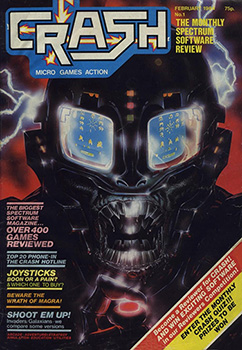
A Brief History of CRASH
The origins of CRASH were radically different from those of its major rivals. It was established by Newsfield, a publishing company based in Ludlow, Shropshire to provide a cheap alternative to SU and YS. The original concept behind CRASH had been to provide a low-key, low-cost magazine, mostly in monochrome, to attract the numerous software houses who couldn't afford the advertising rates of the existing glossies, so several of the first issues were printed on cheap newsprint with a heavier colour section wrapped around it. This did not last long and the magazine soon became as glossy as its rivals.
What made CRASH unique was the way that it was produced. From the start, the magazine aimed to be a fanzine-writ-large: the games reviewers were native Ludlovians (many in their teens) and many of the other contributors were genuine Sinclair enthusiasts rather than simply jobbing journalists working for a large publishing corporation. The strategy gaming correspondent, for example, was a (female) Oxford University student. This gave the magazine a feel of being a professional publication produced by enthusiastic amateurs; not quite the case, of course, but enough to give it a very different flavour from YS or SU.
CRASH's formula was so successful for so long that it went through surprisingly few major changes during its eight years of publication. From its launch issue in April 1984 through to mid-1989, it was a fairly thick publication of upwards of 100 pages a month. The content was dominated from the start by games reviews, previews and hints, plus feature articles about games companies and programmers. The emphasis on games to the exclusion of most else did at least have the positive benefit of allowing much more in-depth coverage. The magazine soon gained a reputation for reliable reviews and gained real power in the software industry; distributors cited CRASH as being their chief guide to making the all-important stocking decisions, estimating how popular a particular game would be likely to be (and therefore how many would be sold and how many should be distributed). It was, for example, no accident that CRASH got closer to the elusive and legendary Ultimate Play the Game than any other British computer magazine.
Unfortunately for CRASH, it became the first victim of the cut-throat circulation war which was waged from 1989-92 between it, SU and YS. With the 8-bit market shrinking rapidly as obsolescence loomed, every 8-bit magazine found itself competing for a declining number of customers. In an attempt to boost circulation, every month all three Sinclair magazines gave away free tapes containing half a dozen or more back-catalogue commercial games. The extra cost of the tapes caused a drastic cutback in the editorial content of the magazines. CRASH slumped from 90-100 pages a month (early 1989) to only 50 or less (late 1989). A year later it was sold to Europress Publishing. In 1992, with circulation still falling, it was merged with EMAP's Sinclair User. Only one merged issue was published, in May 1992. SU soldiered on until the following April before finally falling by the wayside, followed by YS a few months later.