
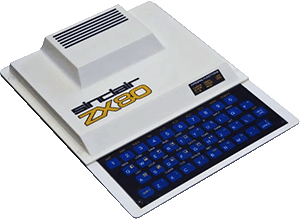
ZX80
Science of Cambridge, 1979
The ZX80 is widely regarded as having founded the British home computer market, but it was a modest foundation indeed. Personal Computer World's acid verdict on the machine indicates its extreme limitations: "with an unusable keyboard and a quirky BASIC, this machine discouraged millions of people from ever buying another computer" (PCW, October 1985). That was surely too harsh, as only around 70,000 were sold - a third more than the MK14, which was even less user-friendly, but bearing no comparison to the millions of ZX81s and Spectrums later sold. It is today a very rare machine, with working models selling for upwards of £100.
The real significance of the ZX80 is that, at the time, it was one of the smallest and cheapest home computers in the world. It was one of the first aimed at the home user, as opposed to the hobbyist or professional. Most previous computers were either been large and very expensive pieces of business equipment (a 20Mb Winchester hard disk drive at this time cost over £2000, while memory cost £16 per kilobyte) or were caseless circuit boards which the user had to assemble himself. Sinclair's own MK 14 of 1977 fell into the latter category.
The great innovation of the ZX80 was not one of technology but of marketing. Sold in two versions, a self-assembly kit and a ready-built computer, for the first time the man on the street could take home a sub-£100 computer and plug it into his television. This was a formula which Sinclair repeated with great success for his later computers.
ZX80s were also exported in small numbers to the United States, but it was not until 1981 that Sinclair entered the US market in earnest.