
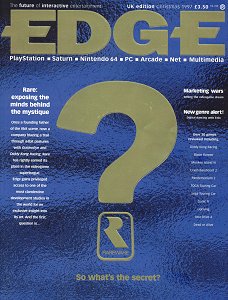
Rare Interview, Edge, Dec 1997
Rare speak exclusively to Edge magazine
This interview was the main feature in the Christmas '97 edition of Edge magazine. (special thanks to Alistair Nelson for providing the original scans to work from).
Rare: exposing the minds behind the mystique (introduction)
Rare: exposing the minds behind the mystique. Once a founding father of the 8bit scene, now a company blazing a trail through 64bit pastures with Goldeneye and Diddy Kong Racing, Rare has rightly earned its place in the videogame superleague.
Edge gains privileged access to one of the most clandestine development studios in the world for an exclusive insight into its art.
And the first question is... so what's the secret?
From the Magazine Editorial
Rare occupies a unique position in the UK software market. For its videogames aren't necessarily designed with the UK in mind at all - rather it is America, Japan, and indeed the whole world that has become its main consideration. Via it's relationship with Nintendo, Rare has long enjoyed a privileged gateway to a truly vast international market, and chooses to cater for boundless global tastes rather than the more introverted gaming niches sustained by the typical '90s developer.
Of course, its enormous success over the years has stockpiled the kind of resources that most other developers can only dream of. But it seems the company's unique culture and unconventional attitude play just as important a role in moulding its titles into the million-selling successes they increasingly seem to be.
Ironically, this month's exhaustive [14-page] report was originally planned for the magazine's first anniversary issue over three years ago. Since then, the company has grudgingly come around to the idea of breaking its infamous vow of silence and revealing more of its operation.
Naturally, Edge was only too happy to help it share a few secrets...
It is one of the world's most renowned developers. It possesses a catalogue of titles spanning almost two decades. And through its relationship with Nintendo it has become one of the UK's biggest exports. And yet, apart from broadsheet coverage of its absorption into the Japanese-owned monolith last year, the UK's greatest videogame success story has deliberately avoided the attention of the press. Ten years have passed since a games magazine was granted full access to its development facilities, in which time the company's publicity-shy reputation has been reinforced (wielding a Dictaphone around these parts is tantamount to carrying a gun). But after years of waiting, Edge's chance to infiltrate its tightly knit operation arrives.
So what's the secret?

If Rare's low profile is a conscious effort to distance itself from the hype that fuels the games industry, its farmhouse location at one end of a rural village in Twycross, Warwickshire, certainly cultivates the myth. There is no company sign at the entrance, just a portentous notice concerning the presence of guard dogs.
But heading down the driveway into the central courtyard past a couple of free-roaming chickens, a car park packed to capacity with new sports cars finally betrays the company's videogaming heritage. A Lotus Esprit SE, a Mercedes SLK, and assorted pokey coupes and hot hatches all fast enough to terrify the average driver, congregate with an unassuming regularity. The couple of Ferraris lurking in a garage are perhaps the best evidence that potatoes and assorted veg aren't what earns a crust here.
The company's reticence to reveal much about its operation can be traced way back to when it was shaping the future of 8bit computer gaming as Ultimate Play the Game. Even then, well over a decade ago, it deliberately steered clear of making its presence felt at the major computing events of the day and distinguished itself from the low-rent crowd with clever teaser advertising and quality packaging. Even its game manuals were unconventional, often using quirky riddle-based messages to unravel their mysteries. The fact that many of the company's vast catalogue of classic games for the 8bit computers are still fondly remembered by gamesplayers today is a testament to their ingenuity.
Edge has been on Rare's case since the magazine launched in late 1993. Back then the company was in a hazy transitional period with its attention divided between 8bit and 16bit technology, but also with an expectant eye focused on the possibilities of 'Project Reality' - something which would later become the Nintendo 64. This investment in state-of-the-art workstation technology directly lead to the creation of the landmark SGI-rendered Donkey Kong Country and more recently has allowed the company to set a new high watermark for 64bit software in the form of Goldeneye and Diddy Kong Racing (see p84). Both these titles are ample proof that the company has matured into one of the world's major development concerns.
Edge's visit to Rare is something of a privilege. For the magazine, that is. This is conveyed by the surprise elicited from Nintendo's US PR department that vaguely remembered when Rare's doors were last properly opened to a games magazine (the NES was state-of-the-art technology at the time). More recently a few games journalists may have made the trip to the Midlands to get a look at titles due for imminent release (Diddy Kong Racing, for example). However, such is the level of secrecy employed that journalists have been confined to the protected environment of a demo room instead of being able to roam freely around interviewing its staff (only possible with the prior submission of questions via fax or email). Even on this occasion the company ensures a Dictaphone is running all day to simultaneously tape all communication with Edge.
Paranoia, perhaps? Well, yes, but it's paranoia with a capital 'N' and that's the difference.
The morning of Edge's visit is beautifully clear and sunny, with a refreshing Autumn bite to the air. The photographer assembles the GoldenEye team in the dazzling daylight for a group shot while Edge meets the Rare guard dogs, which calm down enough to be stroked after their initial bout of frenzied barking. Despite this potential flaw in the security, virtually every building has a security camera on each corner perpetually scanning the farmhouse and its outbuildings. Eagle-eyed visitors might notice how the cameras themselves bear an uncanny resemblance to those featured in GoldenEye, tracking the casual stroller in a sinister fashion. Perhaps understandably, Rare doesn't take any chances when it comes to keeping its best-kept secrets well out of the public gaze and the result is an office complex with a security system more suitable to Fort Knox than a videogame developer. But while many of its neighbours have suffered from break-ins, Rare's intimidating CCTV and surveillance systems have so far proved an effective deterrent.
Given the close business links Rare enjoys with its closest partner, Nintendo of America, a 6,000-mile gap actively discourages interference from the parent company. But considering its rich heritage of videogame production it's perhaps surprising that Rare hardly ever receives fan mail and the vast majority of customer feedback is directed at NOA in Redmond on the west coast of the US. Rare's location may not be publicised - the average uninitiated American gameplayer probably doesn't even realise there is any differentiation between the Nintendo brand and the curious Rareware logo. Once eager American fan obviously did know the difference, though, and actually crossed the Atlantic to track down his favourite developer. But incidents such as these are, appropriately enough, rare. Being off the beaten track does ensure it relative obscurity compared to most large-scale developers. As managing director Tim Stamper puts it, "it's insulated".

Being insulated isn't just a result of its geographical position, though. It's virtually a self-enforced doctrine adhered to by its 100-plus staff that help to ensure information about its games stays within the company's walls. This is a kind of loyalty that seems to be embedded in the fabric of Rare's culture, rather than just the result of a repressive directive from the company's management. It stems from every staff member feeling like they have something to gain from protecting their work until it's complete. Despite this, former Edge staff writer George Andreas - now working at Rare as a designer on Banjo-Kazooie - recently confided that it would be 'more than his job was worth' to leak information about an undisclosed projects in development at Rare. And far be it from the magazine to have ever considered him a placed source...

Curiously, and possibly one of Rare's most revealing traits, is the fact that almost all of the 100-plus employees at Rare joined the company with no games industry experience. It's hardly an accident either, and there is a genuine belief here that while a lack of experience will mean more training in the beginning, it often harbours a great desire to success and means its new staff are unlikely to bring bad habits with them. GoldenEye artist Karl Hilton completed a BA in Architecture until he realised it would be more fun designing underground military bases for James Bond to navigate rather than real-life buildings. Meanwhile, Lee Schuneman left a career marketing swimming pools before his stint at Rare which now sees him as producer/designer on Diddy Kong Racing.
But how does a company that relies on inexperience staff manage to release such consistently good games? Is it simply a case of having a different attitude? Edge hopes to find the answers in the Rare canteen where a subsidised menu is provided to make up for a dismal lack of local lunchtime eateries. Edge is impressed by the quality of the food and also the impassioned enthusiasts, of its staff. Blast Corps designer Martin Wakeley singles out the company's global vision as a major factor: "With most UK developers you're looking to create games for a section of the UK market, so in terms of quantity of games that you're going to produce is going to be very small. Something I'd never even considered until I came here was the fact that there's a market that's ten or twenty times greater than the UK market in Japan and America, and you can produce quality and open yourself up to a much bigger audience."
Designing for this global market has its price, though, and in Rare's case it's an enormous investment in its staff in the form of one of the biggest Silicon Graphics networks in the country. Edge can't help noticing that while wandering around and meeting team members from various projects, everyone seems to have an SGI workstation on their desks. And if any of the team members require a new piece of software (each often costing upwards of several grand) all they have to do is ask - budgets, it seems, aren't really a factor here.
"You do tend to forget on a day-to-day basis how large-scale this is," adds Wakeley. "And then you have a conversation with Howard Lincoln and you realise you are a actually a core part of their marketing campaign and NOA's whole structure. They rely on you as much as you rely on them."
Edge checks for someone holding answer cards up behind but it seems these feelings are shared throughout the company. The royalties that pay for the brand new cars in the car park are the visible proof that its a philosophy that works, too.
Even spending just a short amount of time at Rare reveals that much of its working practices can be traced back to its relationship with Nintendo in the US, and perhaps more significantly in Japan. Some of its staff have recently come back from the East after being invited out by Nintendo's Kyoto division where it was asked to look at the latest projects and to discuss its approach to N64 development.
"To be fair," concludes Wakeley, "the only real developers of our size in the world are NCL. They have the same sort of problems we have - they're in a very similar position to us. We can learn quite a lot from them and they also learn a lot from us as well."
One thing it could have learned from the Japanese R&D division is that it is going to need to expand. Edge is shown a design plan for the brand new offices that it is set to move into next August. The building are located just down the road from the farmhouse in 90 acres of parkland. It's an idyllic setting and one which its directors hope with give its designers more creative freedom - and just possibly the opportunity to embark on slightly more off-the-wall projects.

As Edge finishes the last of its interviews, many of the staff are now huddled in groups in front of large TVs running multiplayer GoldenEye - an experience that has manifested itself in the daily routine at Rare: many finish their dinner quickly just so they can play for as long as possible. Aside from the glowing reviews it's the most impressive endorsement of one of its own games that a company could hope for. Even the legendary experience that is deathmatch Quake doesn't get a look-in.
As Edge wraps up its final interview Rare's car park erupts into the equivalent of a race track starting grid. It's Tuesday evening and the company's weekly five-a-side match beckons as eager game designers being to rev out of the main drive in a 16 valve-charged convoy. For some, of course, it's just a brief respite and they probably won't be heading home until closer to midnight.
But working at Rare is more than just a job.
And perhaps that, more than anything, is the secret.
Edge: Let's start with this: why has Rare been so secretive over the years?
Tim Stamper: I guess we're not here for the personal publicity, we're here for the publicity of the company; rather than seeing an interview with a picture of somebody and a picture of the game, we're here to promote and push the videogame as far as we can.
Chris Stamper: I think another reason, as well, is that there just aren't enough hours in the day. We're still working ridiculous hours, seven days in the week, and I'd much rather focus on the games we're working on than spend time promoting ourselves. We've always taken that sort of approach.
Tim: We get people writing to us to do conferences and things like that and if we did all the conferences and all of the speeches I just don't know what we'd tell all these people, you know: "write good videogames, see you". [Laughs]
Chris: There's always something to do on the latest games that we're working on; there's always some details that we need to look at, to review, and when you're happy with one part, you just move on to the next, so it never ends, and I'm much happier getting involved with the games than with anything else.
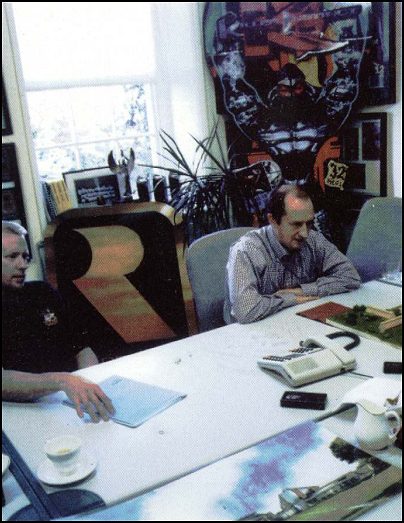
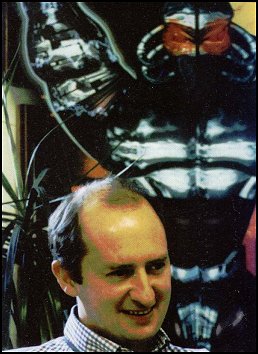
Left: Tim Stamper, managing director, and Chris Stamper, Technical Director
Edge: Was it the same when you were Ultimate?
Chris: Even more so, because there were so few people there that we did everything and there just wasn't any time at all. We were distributing and packing the games in boxes, the whole thing. It was just one big rush in total, there was no time to do anything else.
Edge: Do you think that this facet of Rare's character created a natural synergy when you started working with Nintendo?
Chris: I think Nintendo were very comfortable with us because we weren't publicising ourselves to a great degree. Our objective has always been quality first - that is number one - and I think that we show them these are the sort of games that we can write and that we want to produce and that is foremost in everything we're trying to achieve. I think there's a natural sort of synergy between us [and] I think it works extremely well in the present day; they don't get involved with us at all. I mean, we decide what games we're going to write, we decide exactly what we're going to do. They just expect us to produce great games, and that's exactly what we're here for.
Edge: In terms of keeping everything under wraps on a company-wide scale, how do you implement that?
Chris: We started off obviously as a very small company, we've been growing steadily, we've had our growing pains, but what we try and do is keep the teams in terms of one team working on a project and provide that team with everything they need so that they kind of feel that they are a small company under a larger umbrella, and we try to provide everything that the smaller group actually needs to produce the game. So I think it works within itself - the team, as I say, have everything that they need and they can go ahead and produce, hopefully, a great game. And there is some sort of competitive element between the teams but my job and Tim's job is to make sure that the resources of the company are spread evenly and that advances in one group can be shared with the others.
Tim: I think that the competition we have is fairly healthy. Each team creates its own engine for its game, but there's a company camaraderie that when the game is finished there are all of these resources available to the other groups. But usually then the team gets back down and starts focusing on its new game so that one game will reach there and another game starting will start from this as a springboard and they'll look at that and how they can elevate themselves to a new position.
Chris: It works reasonably well. I mean, if you think of a group like DK Racing, the whole group has a vested interest in that product, so they're the last people that are going to be divulging anything about it and so it's very, very tight. They'll only want the very best for their product, and the other groups know roughly what the product is but they don't have an in-depth understanding, and we like to keep it like that because at some stage in the development of each game we like to call on members of the other teams and say "Look, we've got to this level now, and we think we've got something very special, can we get some of your guys in, we're not going to tell you anything about it; would you like to play it?" and just see what sort of reactions we get. I think there's another issue as well in terms of we've often worked on projects that at some stage, when we have an engine going and we can see what sort of game we have, that isn't a guarantee that it's going to go ahead. There have been quite a few games that we've worked on that we said "That's just not going to make it", and we axed it there.
Tim: That could have been nine months of development when the games is suddenly axed and the public would never see it and that's a difficult situation for a third party company to be in which has a deadline to reach, which is paid to produce a product, they're almost pushed down the road and must finish the game, whereas I think that we have a little bit of leeway and flexibility that if a game's not going right we can axe it and we can start again and regroup. I just think it makes for a better game for the marketplace and if shots were released before that game out you might get a different impression of what was intended to be released.
The Nintendo Connection
Edge: You mentioned Nintendo's marketing teams not being involved with your products - does that mean that only people such as Hiroshi Yamauchi, Shigeru Miyamoto, and Howard Lincoln are given access to that information?
Chris: They don't really know the games that we're working on, we decide at Rare all of the games that we're going to write and then they will be the first people that will actually see the game in progress but the design and the initial decision to go ahead with that game happens here.
Edge: That's interesting considering the general perception tends to be that Rare and Nintendo work hand-in-hand, certainly with some of the bigger and more recent releases. Isn't that the case?
Chris: No. They obviously would indicate, you know, they'd say "We'd love this type of game" or whatever, and we would certainly listen, but we pretty much decide what it is we want to produce.
Edge: So wasn't it difficult dealing with a Nintendo property like Donkey Kong?
Chris: It was, but you have to remember there was nothing available on Donkey Kong before we actually took it on board - it didn't have anything, it had not been developed, it was just this small sprite from this arcade game from way back. When you say "Donkey Kong" now you don't think of the old game, you think of the new game.
Edge: How do you feel about the child-oriented nature of most of Nintendo's games? GoldenEye seems to fly right in the face of that - was that deliberate?
Tim: I think that if you look at successful films, there aren't that many successful films that aren't PG rated. Films have to go across the board to be very, very successful and we're here to write a successful product and not target a core or specific audience. There are a lot of games now that are dark and depressing and kids don't want to play those. And all of these companies out there producing these types of games, maybe they're writing games for themselves and not for the audience.
Edge: Do you not feel like writing a game for yourselves, occasionally?
Chris: I love the games that as you say are Nintendo-style games. DK Racing for me, that sort of style would never stop me from playing that game - I think it will have appeal across the generations, and I think that's great. I don't want to play these games which are targeted or skewed for the higher age groups, I want to play something that's fun.
Edge: So how do you feel about the graphical content in GoldenEye?
Chris: I thought that was great. I think that it's excellent that Rare is in a position now to allow its teams to look at that style of product. I wish somehow we could get that sort of gameplay and skew it slightly younger as well, because I still think that those people that are interested in gameplay itself would play the game itself regardless of whether it looks slightly cuter. But, yeah, I think id does show the sort of things that Rare is capable of.
Edge: Were you not worried about Nintendo's reaction to the violence in GoldenEye?
Tim: Yes, we were very worried. [Laughs]
Chris: But you must remember that it is a known quantity, it is understood: Bond is licensed to kill.
Tim: And not licensed to limp. [Laughs] I mean, the character wasn't created by us, we were just producing the game around the movie and I think the job that was done was tremendous.
Edge: Will there be a sequel?
Tim: Yes, the Bond team are working on another game.
Chris: And at the moment they're working to make some significant improvements to the engine so I'm sure they'll come up with something very exciting for the future.
Edge: Which of Rare's N64 titles do you think is the best to date?
Chris: They all have their merits, I'm very proud of the N64 games we've made. I think Bond is a wonderful game and DK Racing is as well - they're just excellent games. They're certainly in my collection.
Edge: You mentioned Rare is autonomous when it comes to a game's contents, but do you have much communication with Nintendo in Japan?
Tim: Yeah, we occasionally visit them.
Chris: But we don't have any input as such into their games. When we visit them they show us what they're working [on] and when they visit us we show them what we're working on.
Edge: You seem to share a similar design philosophy...
Tim: I think we've been working with them for so long, we've been working with them for 12 years, 13 years - it's a long time. And our sort of target audience is the same as theirs. We want games to do well in Japan and America and it wants to be basically the same game, and it's taken a long time to and a lot of hard work to achieve that.
A One Format Company
Edge: At the moment, Rare must be one of the few developers in the world that isn't working on the PC. Why is that?
Chris: I'm very, very comfortable working on the N64. I see the PC as something of a nightmare in terms of trying to produce games for that platform. For myself, involved with the technical side, the N64 is a wonderful machine to work on....
Tim: That doesn't mean to say we don't play PC games; we do.
Chris: [Laughs] That's true, but the thing I like about the N64, and I don't think many people realise, is that because it's a cartridge based machine, although some people see that as a disadvantage, each time you add a larger cartridge to the N64, you're changing the whole machine itself, it becomes more powerful. As time progresses, the N64 is becoming a more capable machine. The PlayStation is pretty much fixed in what it is but the N64 has a capability that's expanding, so I think you're going to see that the N64 games are going to continue to improve and grow and it's going to be not only the evolution in the techniques that we have but because you can dynamically download so much information from the cartridge, it's like having a bigger machine with more memory. So it's a wonderful machine to actually work on and I think that the future of the N64 is quite interesting.
Edge: But surely it can't be a question of power as a top-end PC with a decent card is arguably more powerful than an N64.
Chris: It probably is, but I don't think there are that many of those configurations in a sense. We're much happier producing on a standard format which we know exists and is designed for actually playing games.
Edge: The PlayStation seems like an easy platform to port games to from the PC - would you say the N64 would be harder to develop in tandem with the PC?
Chris: I think if you're going to develop with your eye on porting it to another platform, I think you're going to make compromises right from the start, and we don't have to do that. We just look at the N64 and say "Okay, what's the best possible game that we can produce on that?", with no thoughts of how we might convert that, and I think that's important. And I think also, which is something we touched on before, we want to be in a position where we can throw enough resources at developing a game and then feel comfortable that we can get that return back to carry on the process. I don't think we could [do] that on the PC and I don't think we could do that on the PlayStation. I think it's too confused a market.
Rare's Coming of Age
Edge: Have these resources come solely from the Nintendo deal?
Tim: I think it was the process of going through all the types of products that other companies have to go through - conversions, third party work - to reach the point that we've managed to reach that we had to take on because the company needed to survive, before it could reach a stage where it could produce its own dream product.
Edge: But do you think it would be fair to say that nobody else could have made Donkey Kong Country at the time it was produced?
Chris: I think that's probably very, very true. I think that you have to have the resources and you have to have the confidence.
Tim: We had a meeting about this list of equipment that was required to write Donkey Kong Country and it was colossal, and I guess that was a turning point in the company's life. The safe way would have been to have said "No, we will not buy that equipment yet, we'll wait until the price comes down" and somebody else would have got it, I'm sure. But it was a big decision for the company. If it had gone wrong, it probably would have broken us.
Edge: So was it a case of getting out the calculator and working out how much rendering was required?
Chris: Yes, we worked out how much the SG equipment and all of the licences for the seats would cost us. It was a lot of money, a big investment for that type of game.
Edge: Presumably the profits more than balanced the books?
Chris: Well, yes, I think it's in "The Guinness Book Of Records". It's just a phenomenal seller.

Edge: Which game are you proudest of, or have the fondest memories of?
Tim: The ones we haven't written yet. [Laughs]
Chris: We have fond memories of a lot of games - they all have meanings for certain reasons. Obviously DK Country is a wonderful game and we have some wonderful memories of [it]. At the moment I think DK Racing is a wonderful product, it's something we're very, very proud of - Bond as well. As Tim said it's the later games that we're really interested in and the ones that we're working on now that we find even more exciting
The Importance of Size
Edge: Do you agree with the school of thought that states that there is no longer room in this market for small developers starting out - that they'd find it too difficult to compete?
Chris: It's a problem for sure, there's no question about it, but what's interesting is that now that we are a publisher we are being contacted by small developers, and our philosophy has always been "what does it take to produce a number one best-selling game?", and we're not going to be saying to people "Can you produce a game for this deadline or for this much money?". So I think there are opportunities for those small developers but it does need to be with someone who has the resources to actually make it all happen. The equipment you need, the time you need - it's a big, significant undertaking.
Edge: Presumably there's no way a small outfit with ten staff could try and take on a game like Conker's Quest - it would have to design a game that would reflect its means?
Chris: I think that it's very difficult. I think realistically you need to look at a two-year window to produce something very, very special. Really, you probably need more than ten people to do that and if you want to look at what it's going to cost for 15 or 20 people for two years....

Tim: But every game doesn't have to be like a Conker's Quest. Tetris wouldn't take ten people two years to produce. I think if any of the small development companies have a great idea that they're confident they can pull off and it can work if they had the resources, they should contact a bigger software company and see if they can get some sponsorship or assistance.
Chris: Yeah, I think it's about getting the deal, it's exactly what we did. I think there are steps that you have to take it you think you're going to jump right to the top on the very first game - it's just going to be so difficult to do. There's nothing wrong with moving one step at a time, and that's exactly what we did: we paid our dues by producing a lot of conversions in the early days.
Edge: What do you think of the general quality of software today?
Tim: Working in the software industry it's always great to see other companies producing number one games or games that are really, really good because I think it perpetuates the industry. We're all gamesplayers here, we love to play other people's great games and it is disappointing when you go out onto the streets and take your hard-earned money and you buy a game that looks good and you're unhappy with it. And it's kind of part of our idea - traditionally our audience is younger than the PlayStation audience, which is 21, our core audience is probably the 12 year old - they haven't got a lot of disposable income and it's very, very important that when they buy a game that it's good, and I like to think that we did everything we could to make that game as good as we possibly could because these young kids are going to spend their money on it, so I think that's really important and maybe if other companies had that kind of concept rather than just putting a game out because of getting pushed by the deadline, there'd be more high-quality software.
The Power of PlayStation
Edge: The PlayStation seems to be dominating the market at the moment in terms of sales, installed user base and developer support. What do you make of that?
Tim: Well, I think, with regard to developer support, Sony have made it really easy for a smaller developer to jump online with their system and produce a game that is going to be sold. I don't know how many they're selling, but I gather it's not very many units, especially with a company that is not fully funded. It's far more difficult with Nintendo so I think Sony can proliferate with its number of titles.
Edge: Do you think Nintendo has it right in terms of number of titles out there? If you had the choice, would you prefer to produce more?
Tim: I'd sooner do fewer titles that were of higher quality. I guess the ultimate game is one that would always manage to change itself and you would never get bored with it, like golf, which lots of people get stuck in and get addicted, and it varies every time they play it. Sure, they change the courses, but it's always the same game, and I wonder one day if a videogame would reach that sort of status - that would be a game that would be great to write. And I'd rather see one single high-quality game rather than ten low-quality games.
Chris: I think Sony has a wonderful brand name and they have a very good machine but at the end of the day I think that if it's quality that you're looking for, I think that you have to pick the N64. And if you're looking for a machine whose game quality will continue to improve, the N64 is the only candidate.

Edge: But if you're making games for experienced gamers, how are you going to open up this market to the true mass market?
Chris: The experienced gameplayer will have the opportunity to experience the whole game as it was intended. Our games are designed so that the novice player will still get a great deal of enjoyment. A novice player can pick up something like DK Racing and can begin to win the balloons and open up more tracks and just have a great time on that. The experienced gamesplayers can really start to look and go through the whole two adventures, so that's what we try and design internally.
Edge: Do you not feel there's a risk of alienating the average gamer with something as initially daunting as GoldenEye? Somehow, it's easier to imagine a parent getting to grips with Ridge Racer, for example.
Chris: I think it's down to trying it and experiencing it. I noticed that the rental figures for Bond in the States are astronomical, and it's beating everything else by maybe three to one. So there are a lot of people out there that are trying it saying "Hang on, there's something really interesting in here".
Edge: What do you think about the danger of potentially overcrowding the market with low-quality games?
Chris: If there is an overcrowding, there are too many games, there's confusion, there's a tendency to reduce the price of games because of that. Then how are developers going to generate enough resources to actually produce a triple-A product? It's not going to happen.
Tim: It's kind of getting like the old budget market in the UK in the '80s, when there was a rush of substandard software.
Chris: I would look at the two systems and say that the PlayStation is on a downward market spiral and the N64 is on an upward market spiral.
Edge: Do you not think that if we're heading for a crash similar to the end of the 16bit market, the N64 would be dragged along whether or not it played a major part in the affair? In other words, won't the whole videogame industry suffer?
Chris: I think we're all aware that it is a fashion business, and I think that we have to be ready for the lean times and that's one of the wonderful things about Rare. We're working hard to maintain Rare's position in the marketplace. The PlayStation developers I've spoken to lead a pretty hand-to-mouth existence; when the market changes they're going to be in trouble.
Tim: And it is an entertainment industry, and people are getting more and more spare time and they want to be entertained. so the industry isn't going to be here today and gone tomorrow. I've heard people speculate about this for 15 years, and it's still here and we're still here producing games.
Edge: Do you think that games are getting better, generally?
Tim: Yes, but talking about the mass of PlayStation games, I mean, we're in the industry and I couldn't tell you what all the PlayStation games are like. If you gave me a list of the 300 or so titles released by this Christmas, I just wouldn't know what they're like. And how anybody else, a mother, a father, or brother or somebody who's got a machine - is going to know which game to buy unless they're specifically told is beyond me.
Edge: This is probably why we are seeing an increase in the number of big licences again, which is a side of the industry that is unfortunate....
Chris: We were concerned about taking on the Bond licence but I think because of our reputation we had a lot more flexibility than any other company would have had and we were able to produce something very special.
Videogame Violence
Edge: With regard to GoldenEye, which obviously contains blood and the shooting of human opponents, what are your thoughts on violence in videogames?
Chris: Well, as I said, we felt reasonably comfortable with GoldenEye as it's in a known military style game, therefore there's an implicit understanding that there is violence associated with it. If you buy some other game and then you get innocent civilians being shot in the streets - that I have a problem with. So I didn't have as much problem with Bond because it's a given. But the mainstream effort for Rare's games is to produce games which don't rely on violence. After a while, I think, when you're playing these games you don't notice whether it's violent or not. You may find it entertaining for the first few minutes and then you forget about it and what you're interested in is the gameplay. And you don't need the blood and you don't need the other things like that. I think that the context is very important and I think that having a rating is very important.
Edge: We're now at this hazy stage where in-game animation has advanced to the point where it is convincingly realistic, and within five years it will surely be possible to show truly gruesome levels of details to the player.
Tim: But why would you want to show that? If you want to see that then buy a video. I don't think it adds any gameplay and it's probably not a road that we want to go down. It's just pointless to appeal to that end of the audience like that.
Chris: Yes, I think that's a very short-lived road to take, and I think there's far more mileage in producing games that don't rely on violence for entertainment. It will keep resurfacing, and I think it that the content does need to be indicated on the packaging.
Tim: I think the violence thing is also escalating with the age of the players as well. A 20 year old expects there to be violence in games and 12 year old doesn't.
The Future
Edge: Where do you think you're going to be in five years' time - do you think you'll be developing videogames or do you have ambitions to do something else?
Chris: No, I think that we'll still be around. Our plan is to actively encourage the new generation of designers and engineers within the company. I think myself and Tim are now taking a more overseeing sort of role and I see that continuing. We've got so many great people coming through that already it's more their sort of games that are being produced. I still think we'd be pretty much the same thing.
Edge: There is currently a lot of interest in online games; many are suggesting that it represents the future. What are your thoughts?
Tim: I'll handle this one. [Laughs] I was asked the same question in Japan. I'm not a big fan of network gaming. I think if you have to go and play a game over a network it shows that the AI in the game is not good enough. I think that the probably the best gaming experience we get is when you get a network machine connected to someone you know. In a company building you've got a network and you can play PCs across the network and get your machines connected together and people fighting in groups, and it's really, really good fun. Now, why you would want to play anybody that you don't even know is completely beyond me. In a network game, somebody beats you or you beat them and you can go round and make fun of them and say "Well, you didn't do very well, I kicked your butt - try me next time", it's just part of the whole social thing. But to play somebody you don't know is just such a bizarre concept...
I find it very alien.
Chris: For me, multiplayer games are about four people using one console, with one screen.
Tim: But you have to know the people you're playing with. It's like in an arcade, with a two, three, or fourplayer game - if there are people on there you don't know, people don't generally want to play, especially if they're bigger than you and you beat them...